Apple  ·  Preprint

EgoMM: Towards Multimodal Egocentric Intelligence

A wearable records three streams. The field reads one. EgoMM makes each sensor's contribution measurable, and EgoBuddy turns that measurement into a capture policy for a device worn all day.

Lingdong Kong  ·  Seth Dong Huk Park  ·  Peter Fu  ·  Joshua M Susskind  ·  Afshin Dehghan

Apple

arXiv Code Dataset Live examples
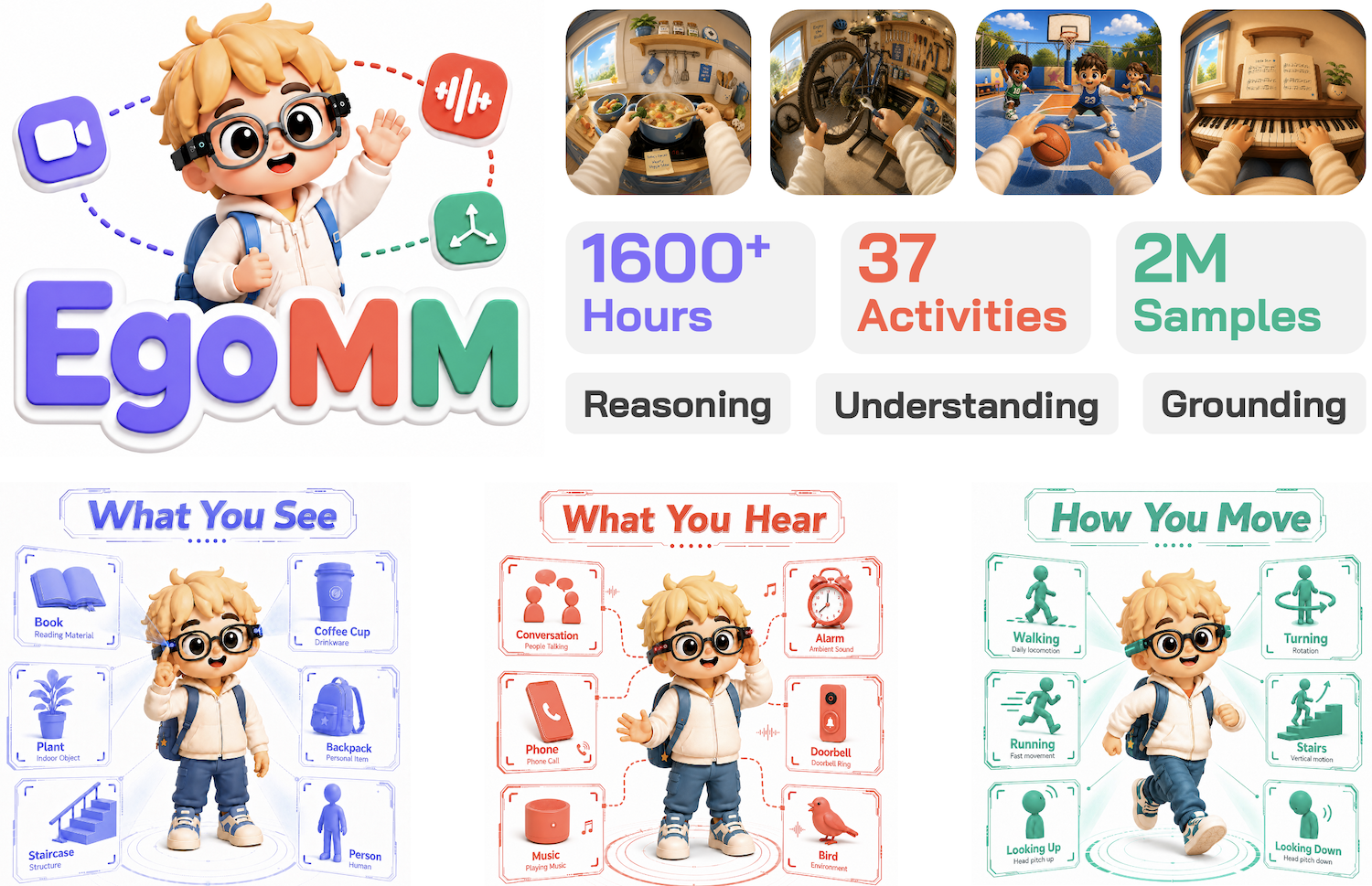
EgoMM overview: synchronized video, audio, and head-mounted inertial motion.

Overview

Modern wearables ship a tightly synchronized sensor stack: an outward-facing camera, one or more microphones, and an inertial unit sampling at hundreds of Hertz. The three are co-located on one body, driven by one clock, and present whenever the device is worn.

Yet the community's working model of egocentric understanding has stayed almost entirely visual. Open video models consume frames and nothing else; the strongest closed systems accept video and audio but ignore motion; and the large egocentric corpora are consumed as silent, motion-blind streams of pixels. That framing is a poor fit for how wearables are worn, because the camera is routinely occluded, dim, or pointed away while audio and motion keep carrying signal.

We build the three things needed to make the cost of that framing visible, and then show what the same structure buys on a device that cannot run its camera at full rate.

Corpus

Synchronized V A I at clip granularity, annotation-grounded.

Benchmark

Every item tagged with the modality it requires; every axis calibrated against a floor.

Model

A compact tri-modal model that encodes the raw inertial stream.

EgoBuddy

Always-on memory, with capture decided from the cheap streams.

Data Curation

An egocentric observation is not a video with side channels. A clip is a synchronized triple: the frames from the outward-facing camera, the waveform from the on-device microphones, and the paired inertial streams from the two head-mounted units, all recorded from one body against one clock.

Clips are drawn from head-mounted rigs that differ in field of view, microphone array, inertial rate, and native axis convention. That heterogeneity is deliberate: a corpus from one device would confound tri-modal understanding with the idiosyncrasies of one sensor stack, so all inertial data is normalized into a shared body frame and the device diversity is kept visible.

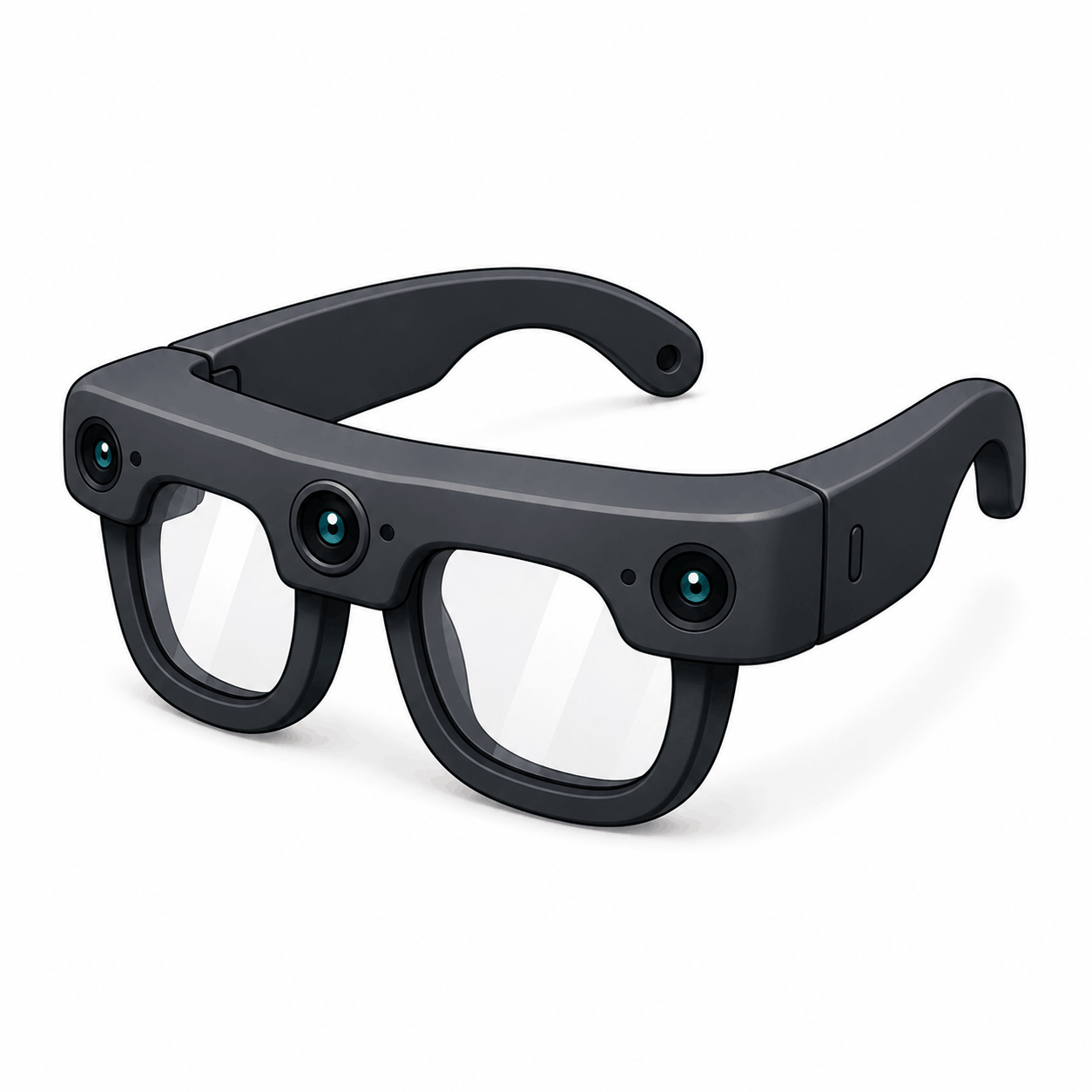
Project Aria
Project Aria

Two on-board inertial units

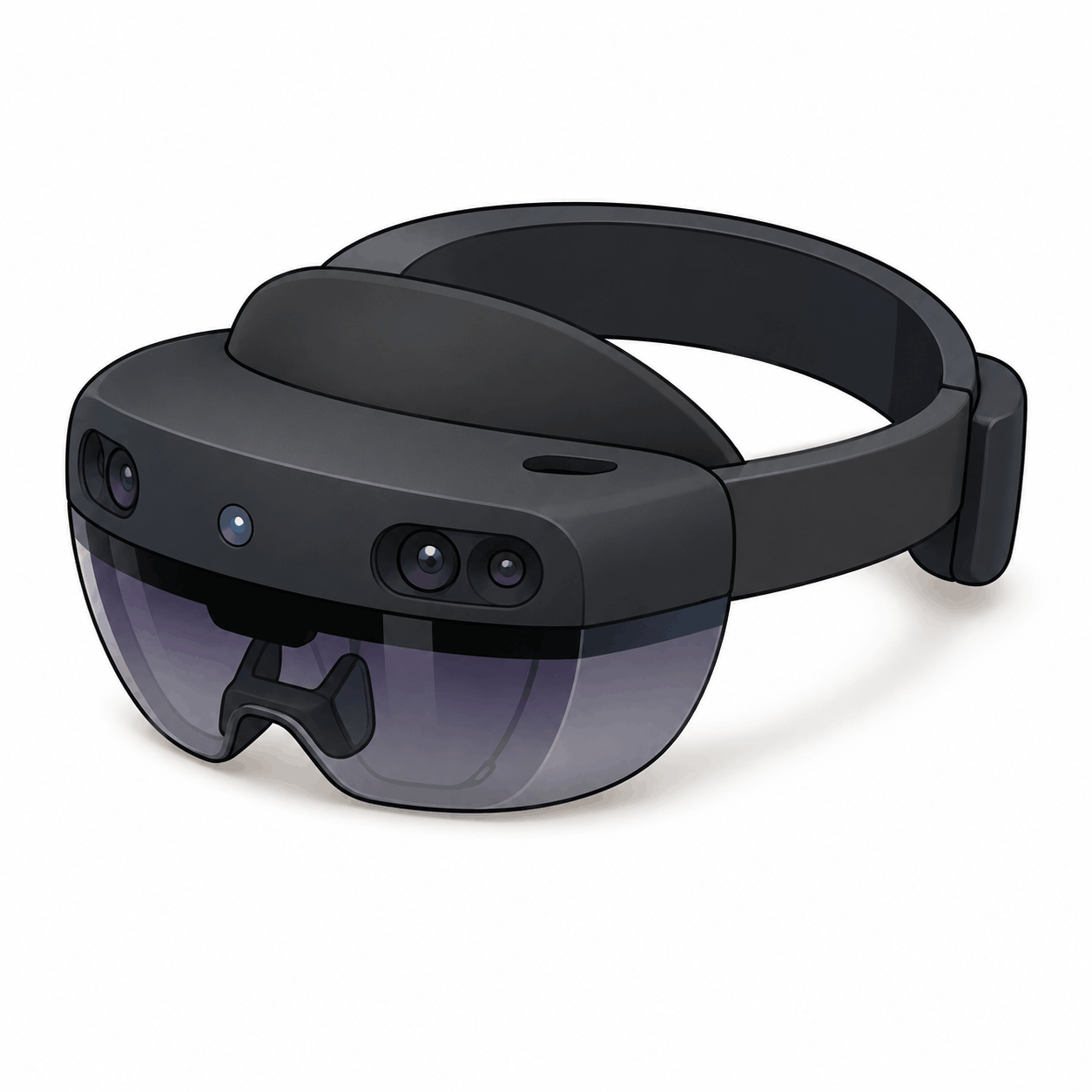
HoloLens 2
HoloLens 2

Single head unit

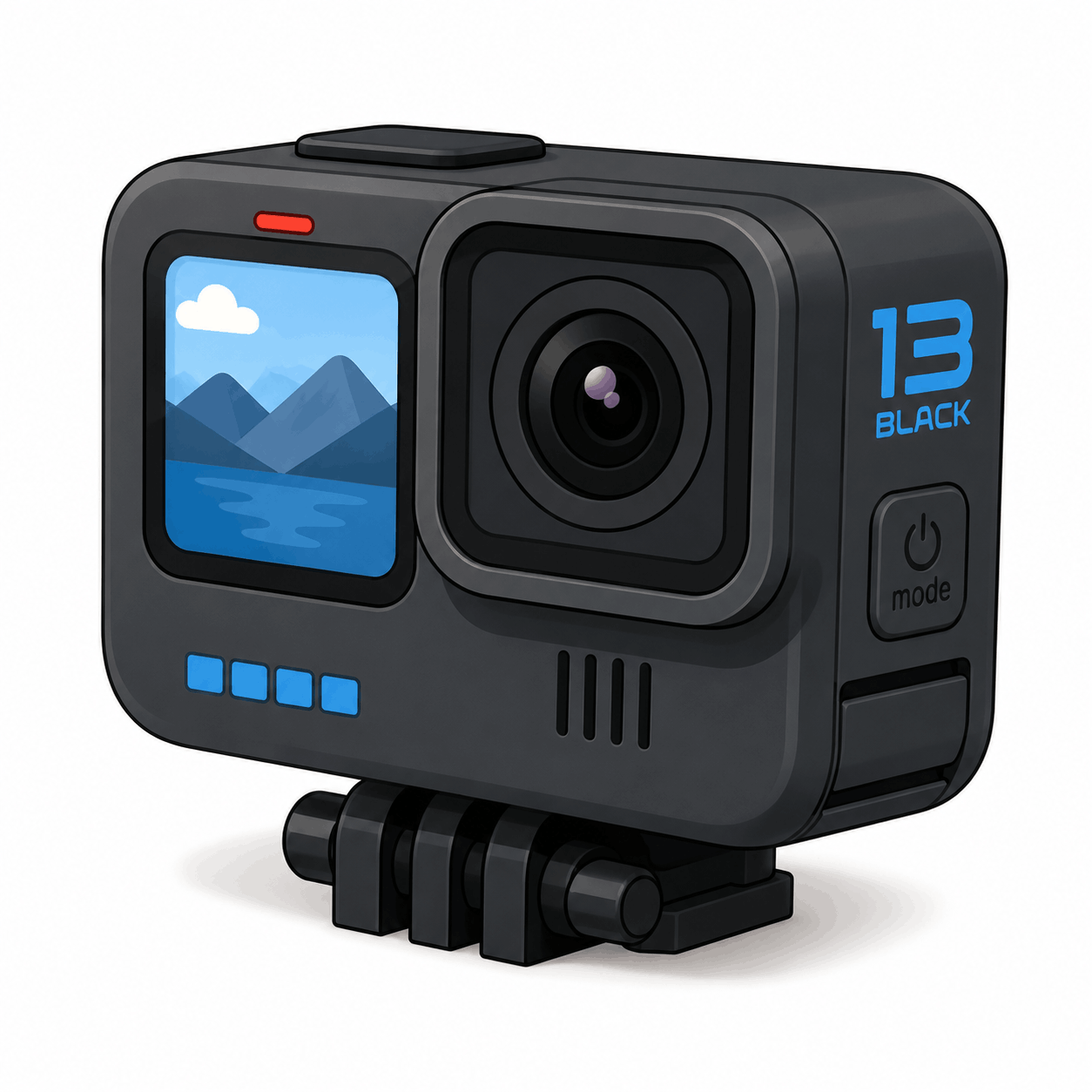
GoPro-class
GoPro-class

Action-camera capture

Activity coverage

The corpus spans seven domains, from unremarkable daily routine to fine-grained skilled activity, which are the two regimes egocentric understanding has to cover.

Egocentric frame from the Daily Living domain.
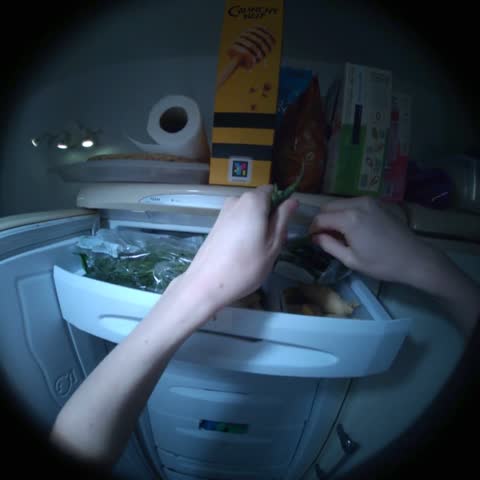
Daily LivingLong unremarkable stretches, which is where a worn device spends most of its time. aea
Egocentric frame from the Cooking domain.
CookingHands leave the frame constantly, and contact sounds carry what the camera loses. hdepic
Egocentric frame from the Social & Play domain.
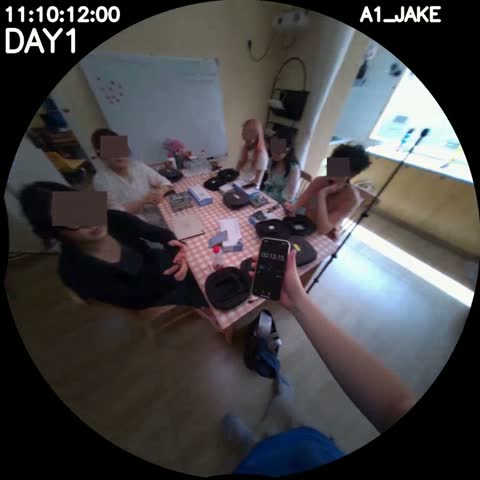
Social & PlayOverlapping speech, several people, and a camera that follows the wearer's attention. egolife
Egocentric frame from the Sports & Fitness domain.
Sports & FitnessSustained whole-body motion that the inertial stream separates cleanly. egoexo4d
Egocentric frame from the Assembly & Trades domain.
Assembly & TradesFine manipulation under instruction, with tools that sound distinct from one another. holoassist
Egocentric frame from the Arts & Crafts domain.
Arts & CraftsRepetitive skilled motion where the sound of the activity is the clearest signal. egoexo4d
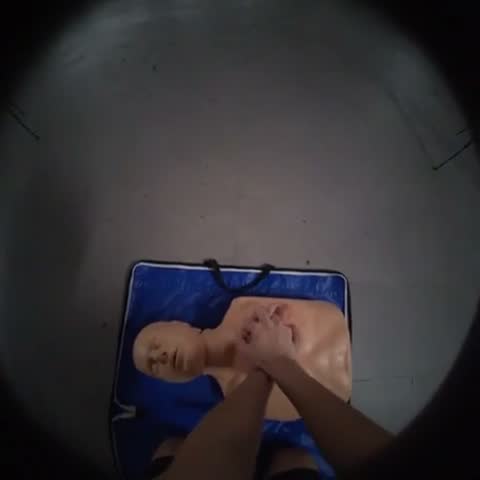
Egocentric frame from the Health & Safety domain.
Health & SafetyProcedural sequences where timing and rhythm matter more than appearance. egoexo4d

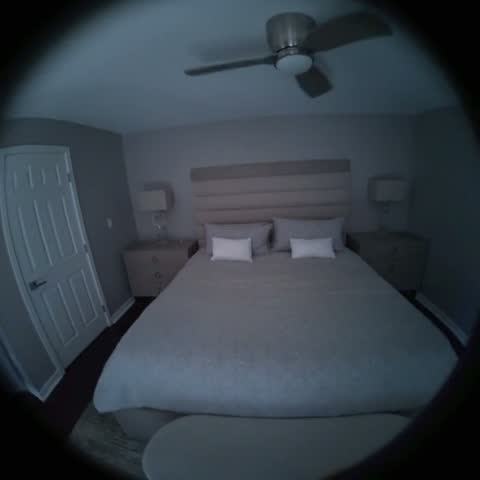
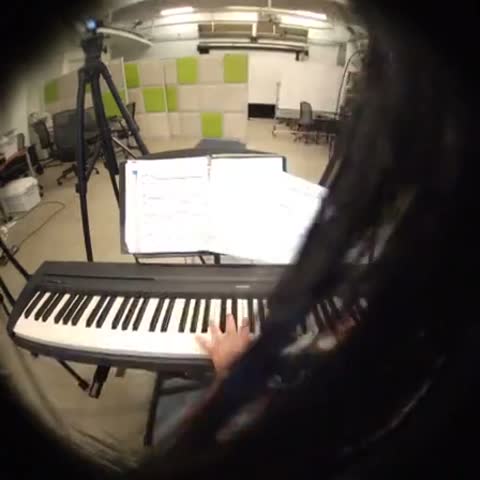
Frames from clips in the benchmark media set, one per domain. They are unretouched, which is why several are dim, tilted, or partly blocked by the wearer's own body: that is the ordinary condition of first-person capture, and it is the condition the other two sensors are there to cover.

The EgoMMU Benchmark

A corpus makes tri-modal models possible; it does not make their behaviour legible. EgoMMU asks one question quantitatively: does a model actually use each sensor stream, or does it score well from priors? A single aggregate cannot tell the two apart.

The benchmark is therefore organized as task × modality. Five task families are each split by the modality required to answer, giving a grid of columns rather than a ranking. Reading a row states what a model can do; reading a column states what a modality contributes.

Multiple choice

V A I

Includes speech-tone questions, unanswerable from frames, and bilateral asymmetry questions requiring both inertial units.

Fact check & open QA

V A I

Fact check scores nothing for a wrong verdict, whatever the justification. Open QA items require a pair of modalities.

Temporal & narration

V A I

Temporal grounding is reported against a constant-span reference, so a score below it is not read as localization.

Every column has a floor

A column is only informative if it measures the modality it names, and that is a property to be established rather than assumed. For each axis we measure the score reachable without the modality under test, by withholding that stream or the media entirely. Items solvable at the floor measure difficulty rather than perception, and are removed. An audio item a silent model already answers is not an audio item.

Motion Signatures

Inertial signal is more discriminative than its low dimensionality suggests. Unlike a wrist- or thigh-worn sensor, a head-mounted unit separates activities by locomotion and head-orientation dynamics: still versus walking versus running, head pitch when looking down at a task, yaw when scanning a room.

Each clip below shows the head-orientation triad reconstructed from the gyro-integrated, gravity-corrected signal, beside the accelerometer and gyroscope traces. Hover to play.

Dance  continuous rotation
Basketball  periodic, sharp turns
Walking  regular cadence
Running  high-frequency gait
Search  yaw-dominated
Cooking  sustained head-down
Eating  gravity-dominated

The EgoMM Model

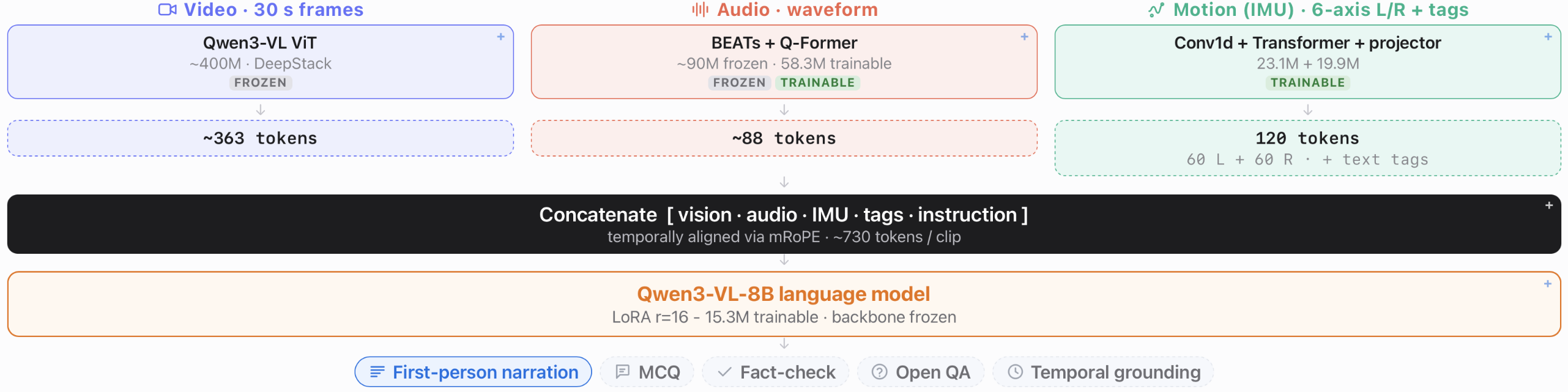
EgoMM extends a strong vision-language backbone rather than replacing it. Audio and motion enter as additional token blocks projected into the same embedding space, with no surgery on the backbone, so the recipe transfers as backbones improve.

EgoMM architecture: video, audio, and inertial encoders projecting into a shared token sequence consumed by the language model.
The EgoMM architecture. Each stream becomes its own block of tokens, time-aligned to the clip. Because a modality is a block rather than a branch, omitting it yields a shorter sequence rather than a different model, which is what lets one checkpoint accept any subset of the three streams.

The motion branch reads the raw signal and is deliberately hybrid: a learned encoder sees the inertial waveform itself, while a rule-based path computes interpretable descriptors, covering locomotion state, cadence, head pitch, intensity, and bilateral symmetry, and presents them as text. The learned path captures dynamics no fixed feature set anticipates; the computed descriptors are exact and auditable.

EgoBuddy: an always-on companion

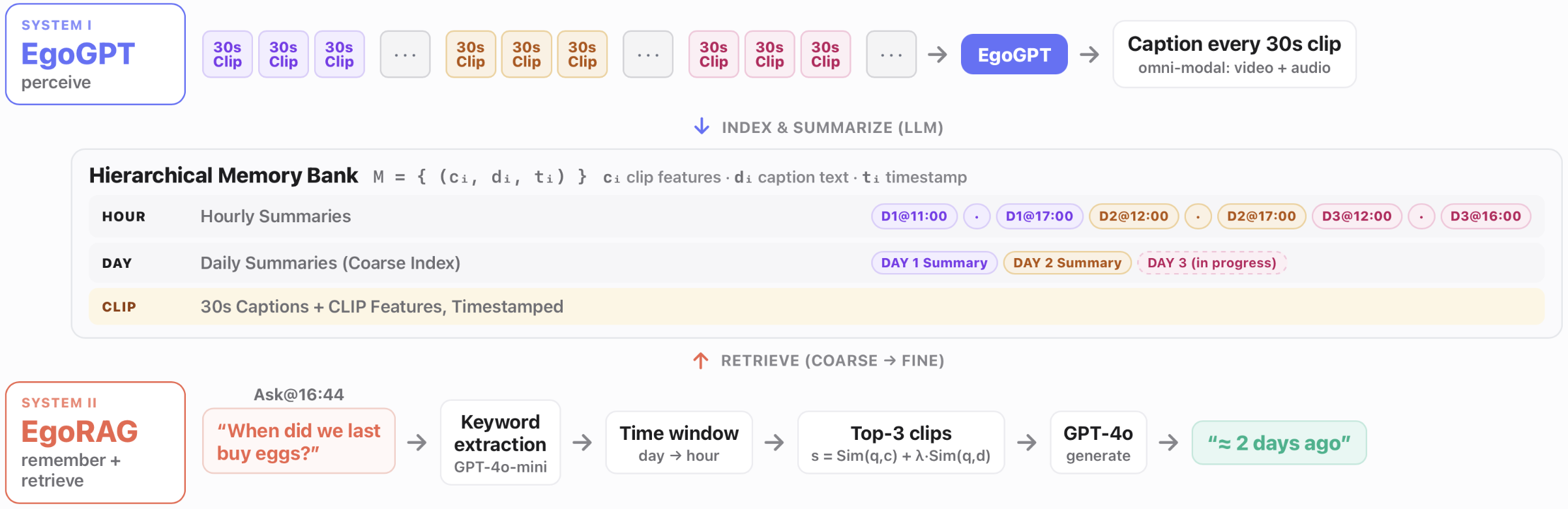
Per-clip understanding is not what a worn device is asked for. A companion switched on in the morning and consulted in the evening must answer from a day it has already lived through, having decided, continuously and without knowing the question, what was worth keeping.

The setting differs from clip-level evaluation in one structural respect: the question arrives after the evidence has passed. A system permitted to revisit the raw stream after seeing the question is solving retrieval over a recording; a system that must answer from what it chose to keep is solving the problem a device has.

The caption-then-retrieve pipeline: per-clip captioning, hierarchical memory, coarse-to-fine retrieval.
The pipeline long-horizon egocentric assistance has converged on. We keep its coarse-to-fine structure and depart from it in two respects: what the captions are written from, and whether the frames they describe were acquired at all.

Capture is a decision, not a sampling rate

The three streams are not equally affordable. Microphones and inertial units draw little enough power to run all day; the camera and the vision stack that consumes its frames do not. And when audio is continuously available, a sparse frame budget already recovers most of what dense sampling records, because much of what can be said about a moment is carried by what was said and done in it.

So EgoBuddy scores capture-worthiness continuously from the streams it pays for anyway, and acquires a frame when they indicate the visual field has likely changed. The decision must be causal: choosing the best frames within a window requires having seen the window, which requires the camera to have been running throughout, which is exactly the cost the mechanism exists to avoid.

It is also irreversible. Frames that are not acquired are never stored, so unlike post-hoc sampling there is nothing to revisit. Condensation becomes a property of capture rather than of compression.

Leaderboard

Per-column results across the task × modality grid, with each column's floor shown as a reference, are released with the paper.

Coming with the paper release

The interactive board will let you sort by any column and filter to a single modality, so the disagreement between columns is visible directly. Two results it will make plain: models that can hear clear video-only ones by a wide margin on the audio columns, while scores on the motion columns follow neither audio access nor parameter count, because no prior system receives an inertial stream at all.

Examples

Every case below is a real item from the frozen benchmark, with the answer every evaluated model actually gave. Nothing here is illustrative: the clip is the clip the models were shown, and the reference answer is the one the item was verified against.

The clips carry their original audio. On the audio items, muting the player reproduces exactly what a video-only model receives.

Multiple choice · AudioA The answer is only in what was said aea · 30 s
During the cleanup process, what specific item does the male speaker explicitly state he will put away?
  1. He states he will put away the fruit. reference
  2. He states he will put away the rule book.
  3. He states he will put away the playing cards.
  4. He states he will put away the game board.
  5. He states he will put away the wooden tokens.
hear what the video-only models were given
0/22models with no audio pathway
7/7models that receive the audio

The item is not ambiguous and it is not hard. It is simply not in the frames, so a model that cannot hear has nothing to work from and picks a plausible object instead.

Every model's answer on this item
No audio pathway
claude-haiku-4-5D
claude-opus-4-6B
claude-opus-4-8D
claude-sonnet-4-6D
claude-sonnet-5D
gpt-5B
gpt-5-miniD
gpt-5-nanoD
gpt-5.4B
gpt-5.4-miniB
gpt-5.4-nanoB
internvl3-2bB
internvl3-38bD
internvl3-78bE
internvl3-8bB
qwen2.5-vl-3bE
qwen2.5-vl-72bB
qwen2.5-vl-7bD
qwen3-vl-2bC
qwen3-vl-32bB
qwen3-vl-4bD
qwen3-vl-8bD
Receives audio
gemini-3.1-flash-liteA
gemini-3.1-proA
gemini-3.5-flashA
phi4-multimodalA
qwen2.5-omni-3bA
qwen2.5-omni-7bA
qwen3-omni-30bA
Multiple choice · AudioA An event the camera never points at egoexo4d · 30 s
While the person visible in the distance is standing near the kitchen cabinets, what is occurring out of view?
  1. A loud fan or ventilation system clicks on and starts whirring.
  2. Water can be heard running continuously into a metal basin.
  3. Someone can be heard sweeping the floor with a stiff broom.
  4. An electronic device emits a distinct series of alert tones. reference
  5. A microwave beeps loudly and its door is pulled open sharply.
hear what the video-only models were given
2/22models with no audio pathway
6/7models that receive the audio

The sound source stays out of frame for the whole clip. Most models without audio settle on running water, which is the likeliest thing to hear in a kitchen you can see.

Every model's answer on this item
No audio pathway
claude-sonnet-5D
qwen2.5-vl-72bD
claude-haiku-4-5B
claude-opus-4-6B
claude-opus-4-8B
claude-sonnet-4-6B
gpt-5B
gpt-5-miniC
gpt-5-nanoB
gpt-5.4B
gpt-5.4-miniB
gpt-5.4-nanoB
internvl3-2bC
internvl3-38bB
internvl3-78bB
internvl3-8bB
qwen2.5-vl-3bC
qwen2.5-vl-7bC
qwen3-vl-2bA
qwen3-vl-32bB
qwen3-vl-4bA
qwen3-vl-8bB
Receives audio
gemini-3.1-flash-liteD
gemini-3.1-proD
gemini-3.5-flashD
qwen2.5-omni-3bD
qwen2.5-omni-7bD
qwen3-omni-30bD
phi4-multimodalA
EgoMM
egomm-9_5b-v6_2D
egomm-9_5b-v6_3_1B
Multiple choice · MotionI The models agree, and the signal disagrees ego4d · 30 s
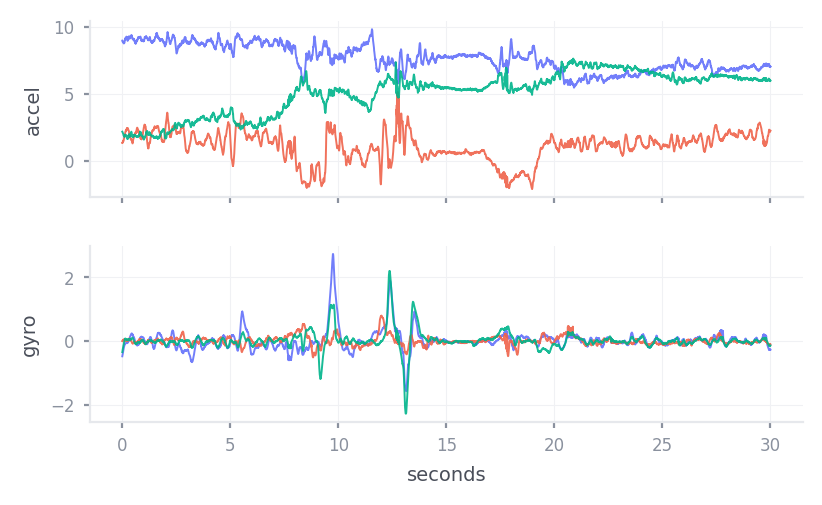
Accelerometer and gyroscope traces from the left head-mounted inertial unit.
How gentle or forceful was the wearer's movement during this clip?
  1. Moderate motion reference
  2. Almost no motion
  3. Gentle, light motion
  4. Explosive, whole-body athletic exertion
  5. Vigorous, forceful motion
From the signal

intensity moderate · RMS 0.52 · cadence 0.00/s · jerk 10.9

6/28models answering without the inertial stream
21/28converge on “Gentle, light motion”

The reference comes from the recorded acceleration rather than from anyone's description of it, so it is exact. A single item is an illustration, not a measurement: what it shows is the shape of the failure, models converging on the visually plausible answer, not the size of any model's advantage.

Every model's answer on this item
No inertial stream
gpt-5-miniA
gpt-5.4A
internvl3-8bA
qwen2.5-vl-3bA
qwen2.5-vl-72bA
qwen3-vl-32bA
claude-haiku-4-5C
claude-opus-4-6C
claude-opus-4-8C
claude-sonnet-4-6C
claude-sonnet-5C
gemini-3.1-flash-liteC
gemini-3.1-proC
gemini-3.5-flashC
gpt-5C
gpt-5-nanoC
gpt-5.4-miniC
gpt-5.4-nanoC
internvl3-2bC
internvl3-38bC
internvl3-78bC
qwen2.5-omni-3bE
qwen2.5-omni-7bC
qwen2.5-vl-7bC
qwen3-omni-30bC
qwen3-vl-2bC
qwen3-vl-4bC
qwen3-vl-8bC
EgoMM
egomm-9_5b-v6_3_1A

BibTeX

@article{egomm,
  title   = {EgoMM: Towards Multimodal Egocentric Intelligence},
  author  = {Kong, Lingdong and Park, Seth Dong Huk and Fu, Peter
             and Susskind, Joshua M and Dehghan, Afshin},
  journal = {arXiv preprint},
  year    = {2026},
  url     = {https://worldbench.github.io/EgoMM}
}